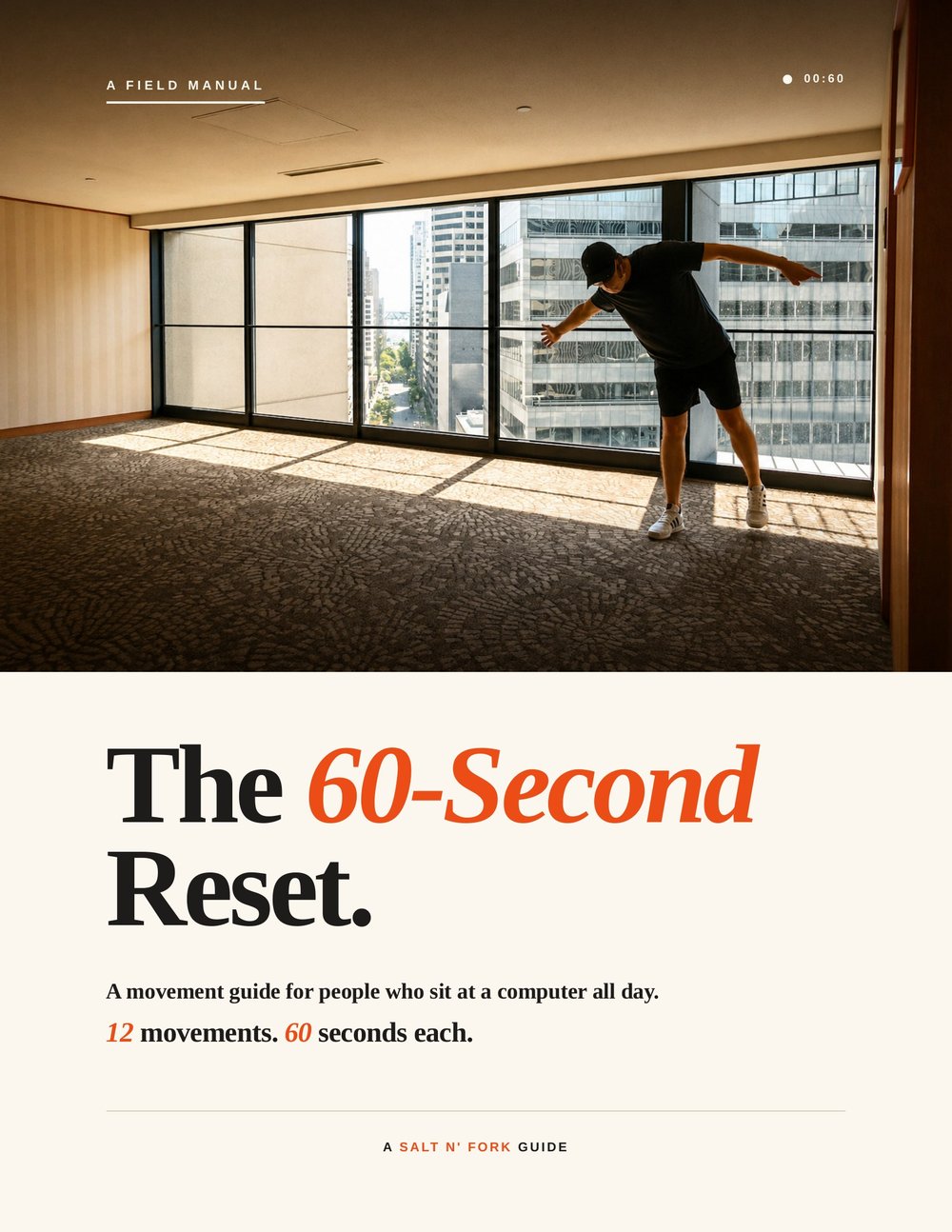
The 60-Second Reset
A movement guide for people who sit at a computer all day.
12 movements. 60 seconds each. 24 pages.
Instant PDF download — book + printable cheat sheet + 30-day starter kit with before/after fitness check.
Get the Book · $9.9930-day money-back guarantee.
Most desk-job movement plans ask you to remember things. Set a timer. Block 30 minutes. Get up every hour. The reason that died for you in nine days is that the plan asked your brain to do two jobs at once. Remember to move, then move. Remembering is the part that breaks.
This book skips the willpower fight. It teaches a stack: a cue you don't control, a 60-second movement attached to it, a return to whatever you were doing. Coffee refill. Slack opens after a focus block. The post-meeting beat. The cue arrives, the movement follows, your brain never had to track anything.
What's inside
24 pages. Plus a printable cheat sheet and a 30-day starter kit.
- The Trigger System. Stacking movement onto things that already happen during your day.
- The Snack Library. 12 movements, 60 seconds each, sorted by where you can do them.
- The Whole System. How the pieces run together in one workday.
- The 4-Week On-Ramp. Adds one thing per week. No calendar pressure.
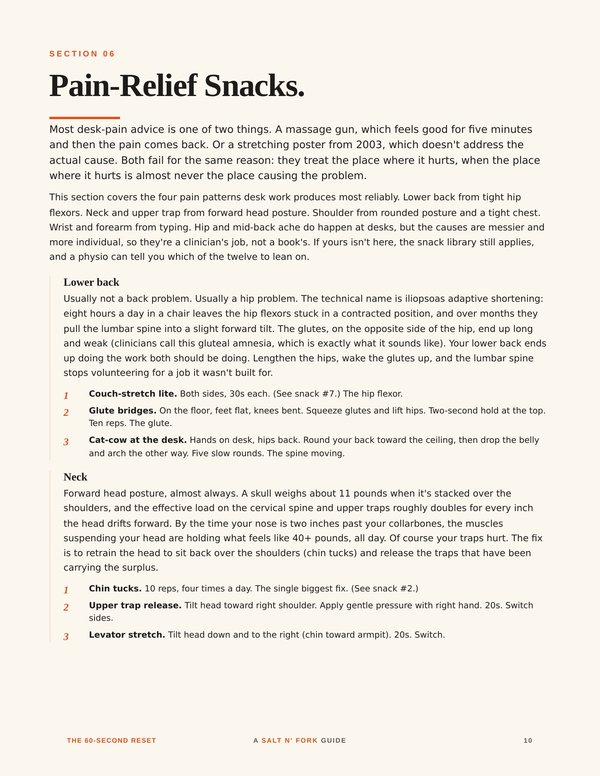
- Pain routines. Lower back, neck, shoulder, and wrist/forearm. Use them when something hurts.
- Strength layer. For anyone past basic maintenance.
- The 30-Day Starter Kit. Snack picker, Day 0 fitness check, 30-day grid, Day 30 mirror. Print it, tape it up, watch yourself change.
- The Movement Snack Cheat Sheet. All 12 movements on one printable page. Fridge or monitor friendly.
- Sources & References. Every claim cited. No "studies show" placeholders.
Who this is for
Anyone whose chair and screen are their primary tools. Office workers, remote workers, hybrid, freelancers. People who've tried apps, gym memberships, and ergonomic gear and watched all of it fail to stick.
What this isn't
A workout program. A yoga book. A wellness manifesto. Anything that asks you to schedule time, change clothes, or believe in something.
About this field manual
This isn't a wellness book. It's a field manual, written by someone who isn't a clinician but who reads a lot of papers and decided to put the actual evidence in one place.
Every claim has a citation. Every movement has a reason it's in the book. The Sources & References section is real — you can pull up the studies and read them yourself. The author isn't the point; the system is.
If you have an injury or a condition, talk to a clinician. If you just want twelve movements that fit inside the workday and a 30-day grid that proves they're working, that's what's inside.
A look inside
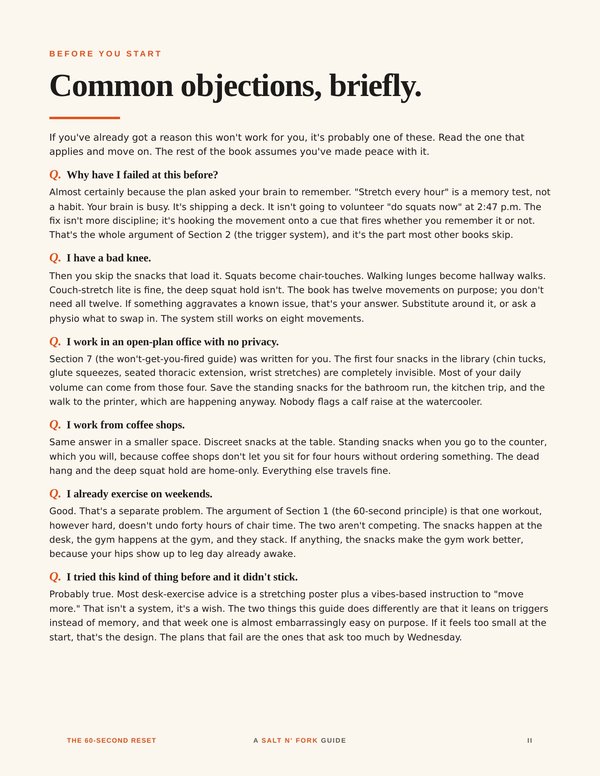
Two pages from the book.
Questions
Do I need any equipment, a mat, or open space?
For most of the twelve movements, no. A chair, a desk, and the floor under you is the whole gym. The one exception is the dead hang, which needs a $20 doorframe pull-up bar — and even that's optional. You can run the full 30-day on-ramp without it.
Can I do these at my desk without leaving the office?
Yes. The twelve movements are sorted by visibility on purpose. The first four — chin tucks, glute squeezes, seated thoracic extension, wrist stretches — are completely invisible. You can do them in a meeting and nobody sees anything. The standing snacks hide inside trips you'd take anyway: bathroom, kitchen, printer. Section 7, "The Won't-Get-You-Fired Guide," covers exactly how to do this without becoming the office curiosity.
Is this safe if I have a back injury or other condition?
Talk to a clinician before starting if you have an existing injury, a known condition, are pregnant or postpartum, take medication that affects balance or blood pressure, or you're returning to movement after a long break. The first page of the book has the full list. The movements are gentle on purpose, but a book can't see you, and pretending otherwise is how books like this damage people. The rule while you're moving: if something hurts in a sharp, pinching, or radiating way, stop. Soreness the next day is normal. Pain in the moment is information to bring to your clinician.
How is this different from yoga apps or stretching routines?
Two things. First, it's built around triggers, not memory — most plans fail because they ask your brain to remember to move, and your brain is busy. The book attaches movement to cues your day already provides, so the workday does the remembering for you. Second, it leans on strength, not just stretching — systematic reviews keep finding that stretching alone doesn't move the needle on desk-related pain, but small doses of strength work across the day does. Push-ups, squats, dead hangs, calf raises. Sixty seconds at a time, never scheduled. And the included starter kit gives you a Day 0 fitness check and a Day 30 mirror — so you don't just trust that the system worked, you measure it.
Get the Book
One-time purchase. Instant PDF download. Yours forever.
- 24-page PDF
- Printable starter kit (with before/after fitness check)
- Printable cheat sheet
30-day money-back guarantee. If the system doesn't fit your day, get a full refund. No questions asked.